By the Guangdong RAY STUDIO production team
Making one shoot serve websites, exhibitions, sales and short video requires more than trimming the same film. Before scripting, identify each audience, viewing conditions, key information, aspect ratio and next action, then plan the master, business modules, short cuts and reusable assets together.
This guide is for manufacturers, brands and marketing teams preparing corporate films, product videos or annual video content.
1. Define the job of each viewing context
Website, exhibition, sales and short-video audiences differ. Without clear tasks, post-production becomes repeated shortening of one film rather than meaningful adaptation.
The website version builds an overall understanding quickly: who the company is, its core business, credible capabilities, and where to explore products or contact the team.
The exhibition version must work amid noise, irregular viewing and looping playback. Images and captions should communicate the brand, products, strengths and key figures even without sound.
Sales versions need selectable modules for products, processes, R&D, quality management or services, depending on the customer's questions.
Short videos need a specific question or detail as an entry point. Plan vertical composition, subtitle areas, opening information and a continuing series before the horizontal master is finished.
2. Build a content-use matrix before scripting
Before narration and storyboards, confirm for each use:
1. Channel: website, exhibition, sales presentation, WeChat Channels, Douyin, official account or recruitment page.
2. Audience: procurement, brand managers, distributors, investors, applicants or consumers.
3. Task: build trust, introduce products, explain processes, show cases, generate enquiries or support recruitment.
4. Viewing conditions: horizontal or vertical, sound or silent, continuous or interrupted viewing, and who controls playback.
5. Required information: positioning, product names, technical features, applications, contact details or a call to action.
6. Deliverables: master, short cuts, clean versions, vertical videos, cover images, stills and reusable footage.
This matrix turns a request for “a corporate film” into an account of which content the company will use in real situations. It gives scripts and shot lists a clear basis.
3. Plan three layers of content
First, a brand or corporate master communicates positioning, core business, evidence of capability and image for websites, main exhibition screens, introductions and meetings.
Second, business modules cover products, manufacturing, R&D, quality, services, cases and interviews independently. Sales teams and product pages can access the relevant section directly.
Third, short content addresses one question, product detail, expert judgement or real working situation for WeChat Channels, Douyin, official accounts and recruitment.
These layers can share a shoot without using identical shots or information sequences. Clear preparation gives editors more flexibility.
4. Plan horizontal and vertical footage on set
Horizontal video suits websites, exhibitions and meeting screens; vertical video suits mobile short-video viewing. Cropping alone cannot solve every difference.
Identify people, product actions and details needing both compositions. Leave safe areas around key subjects, allow for interview subtitles and eyelines, check whether equipment operations fit vertically, and schedule repeated actions for different formats where necessary.
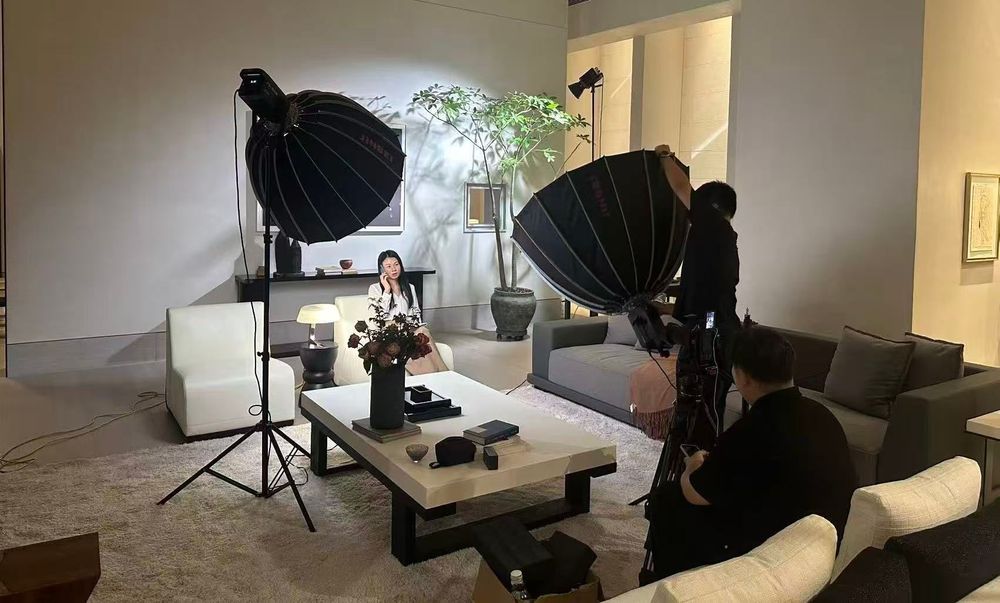
On a RAY STUDIO commercial shoot, lighting, camera positions, subject placement and intended aspect ratios are coordinated on site.
5. Organise shot lists by module
A list designed only for one three-to-five-minute film may miss valuable reusable material. A practical list includes:
• Exteriors, interiors and working environments.
• Complete products, structures, details and real applications.
• Production, R&D, testing, delivery and service workflows.
• Useful contributions from managers, technical staff and frontline employees.
• Equipment, certificates, data and project sites that demonstrate capability.
• Still images for covers, posters, recruitment and social media.
• Horizontal and vertical footage, establishing shots, ambient sound and transition material.
Not all of this belongs in the master, but it supports product updates, exhibitions, sales presentations and short-video topics later.
6. Specify deliverables before quoting
“Multiple versions” needs a defined scope: film count, aspect ratios, approximate durations, languages, subtitles, music rights, revision rounds and archiving arrangements.
Deliverables may include the corporate master, business modules, horizontal and vertical shorts, clean and bilingual versions, cover stills and organised reusable footage. Choose quantities around budget, filming conditions and real use, rather than producing many near-identical versions.
Multiple versions add planning, filming, editing, captions, graphics, review and file-management work. They are not simply repeated exports. Clarify which versions share a structure and which need a new edit.
7. Assign responsibility for asset management
A designated person should maintain masters, subtitled and clean versions, vertical videos, covers and reusable footage under consistent naming rules. Record usage permissions for customer imagery, performers, music, fonts, drone footage, third-party assets and confidential information.
Files scattered across personal computers, chats and temporary cloud folders make future product updates or exhibitions harder and reduce the shoot's long-term value.
8. Four common mistakes
1. Deciding short-video needs after filming the master, leaving gaps in vertical compositions, specific questions and complete actions.
2. Using one long film everywhere despite different viewing conditions and information priorities.
3. Agreeing only on finished films, leaving footage and version delivery ambiguous.
4. Creating similar videos just to increase the version count. Solving real communication tasks is the goal.
9. Frequently asked questions
Are multiple versions always much more expensive?
No. Cost depends on scripts, filming days, locations, crew, equipment, animation and delivery volume. Planning allows shared footage, but extra planning, vertical shots, editing and graphics still count as work.
Can an old corporate film be cut into short videos?
Check accuracy, quality, composition and permissions for music, performers, fonts and customer imagery first. Suitable footage can be reused; missing vertical coverage or changed products may require new filming.
When should clients confirm version requirements?
During quoting and scripting. Late requests for new aspect ratios, languages, modules or quantities can affect filming, schedules and costs.
10. RAY STUDIO's recommendation
Prepare business objectives, channels, existing footage and desired versions first. A content matrix, script structure, shot list and delivery schedule will then produce a more useful long-term result than starting with duration alone.
RAY STUDIO provides corporate film planning, short-video strategy and multiple-version delivery across Guangdong. Corporate films: https://raystudio.art/services/dongguan-xuanchuanpian. Short-video operations: https://raystudio.art/services/dongguan-douyin-daiyunying.
Related reading: https://raystudio.art/news/l7w6vx4vn4w233h83kl3l9vb
For website, exhibition, sales or short-video projects, outline your use cases and deliverables at https://raystudio.art/contact#project-brief-form.